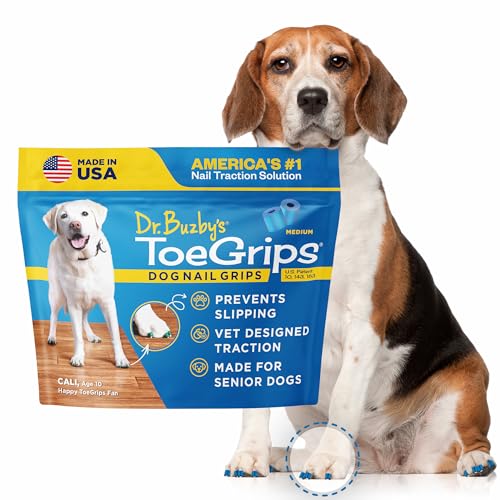
ToeGrips (Dr. Buzby's)
by Dr. Buzby's
The product that gave Heidi back the confidence to move around the house.
Good For
- Dogs with knuckling or proprioceptive deficits who are still attempting to walk
- Hardwood, tile, or laminate floors where sliding is the main problem
- IVDD recovery and neurological conditions causing hind-limb weakness
- Any dog who's tentative on hard floors after an injury or surgery
Not Ideal For
- Dogs who live primarily on carpet (minimal traction benefit)
- Fully paralyzed dogs with no weight-bearing on any legs
When Heidi was recovering from IVDD, one of the strangest problems wasn’t pain — it was the floor. She’d lie in one spot for most of the day, and I kept assuming it was fatigue or depression. It took a while to realize that part of what was keeping her still was simply that she didn’t trust the floor. She’d take a few tentative steps on the hardwood, feel her feet slide, and stop.
ToeGrips changed that within two days. They’re small rubber rings that slide onto the toenails and grip the floor as the nail pushes down. The mechanics are simple — your dog’s toenail is the natural contact point with hard floors, and these add traction directly there. Within a day or two of putting them on Heidi, she started moving more willingly around the house. She started exploring again. That shift in confidence, watching it come back one small step at a time, is something I still think about.
For sizing, toegrips.com has a detailed guide based on toenail diameter, and their team is genuinely helpful if you’re unsure which size to order. Your vet can also fit them, and it’s worth asking if you’re already at an appointment. Getting the right size matters — too loose and they spin, too tight and they’re uncomfortable.
A few practical notes: ToeGrips work best on bare floors — hardwood, tile, laminate. If your dog spends most of the day on carpet, they’re less necessary. They wear down over time and need to be replaced, typically every few weeks depending on activity level. And they’re most useful for dogs who are still weight-bearing on at least their front legs. For a completely paralyzed dog with no hind-limb movement, the benefit is lower — though front-leg traction still matters for scooting and repositioning.
If your IVDD or neurologically affected dog is slipping and losing confidence on floors, this is the first thing I’d try. It costs almost nothing compared to most adaptive equipment, and the payoff can be immediate.
ToeGrips (Dr. Buzby's)
$39.99 USD In Stock
Price last checked September 14, 2026 — Amazon's listing is always the current price.
These are affiliate links. We earn a small commission if you buy through them, at no cost to you. Read more about how we choose →