Why Your DM Dog Is Slipping and What Actually Helps
DM causes proprioception loss, turning hardwood floors into a hazard. Here's what caregivers wish they'd known sooner — and the fixes that actually work.
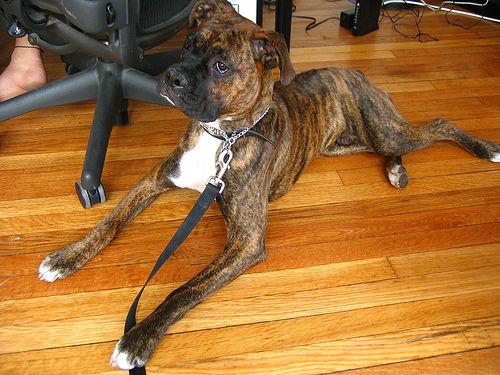
When a DM dog starts slipping on the kitchen floor, it’s not clumsiness — it’s the disease taking away their ability to feel where their feet are.
What Is Actually Happening in Your Dog’s Nervous System?
DM progressively destroys the white matter of the spinal cord — the “communication cables” that carry signals between the brain and the limbs. One of the first casualties is proprioception, which is your dog’s ability to sense where their paws are in space without looking at them.
Think of it this way: if you closed your eyes and someone moved your hand, you’d still know roughly where it was. That’s proprioception. DM dogs lose this. Their paws can slide out from under them and their brain doesn’t register it fast enough to correct. On carpet, tiny fibers catch the nails and provide enough feedback to compensate. On hardwood or tile, there’s nothing to catch — just a smooth, unforgiving surface and a dog who can’t feel what’s happening until they’re already going down.
As VCA Hospitals describes, proprioceptive deficits are among the earliest observable signs of DM, often appearing as “knuckling” — where the dog walks on the tops of their paws instead of their pads. Slipping on floors is the same underlying problem expressing itself differently.
This is also why DM slipping looks different from an older dog being a little wobbly. It’s not weakness alone. It’s a neurological disconnect that’s happening in real time, and it gets worse on certain surfaces.
- Slides when turning or changing direction, not just walking straight
- Paws splay outward (“splaying”) on smooth floors
- Knuckles over — walks on the tops of paws instead of pads
- Recovers more easily on carpet or rugs than on hard floors
- Rear end swings out during walks
Why Hardwood and Tile Are Particularly Dangerous
On smooth surfaces, a dog with normal proprioception still slips occasionally — think of a puppy on a wood floor. They catch themselves because their brain gets instant feedback and triggers a rapid correction.
A DM dog can’t do that. The signal is degraded or missing entirely. By the time their body registers “paw is sliding,” they’ve already gone down. Repeated falls cause more than bruises — they cause anxiety. Many DM dogs start refusing to cross certain rooms, or they hesitate so long before moving that they tire themselves out before they’ve gone anywhere. That reluctance can look like depression when it’s actually fear, and it genuinely accelerates muscle loss because the dog is moving less.
There’s also a real injury risk. A hard fall on tile can bruise a hip, sprain a front leg, or cause enough pain that your dog goes off food for a day. For a dog already managing a progressive neurological disease, any setback matters.
What Are the Immediate Fixes You Can Put in Place Today?
The most effective immediate interventions for a DM dog slipping on floors are traction aids — things you can add to the environment or to your dog’s body that don’t require a vet visit or a major renovation.
Here’s what works, roughly in order of how fast you can implement it:
Yoga Mats and Rubber Runners
Yoga mats are the fastest, cheapest intervention there is. Lay them sticky-side-down across your hardwood or tile and they stay put without tape. A standard mat covers a meaningful strip of floor — enough for a feeding station, a sleeping area, or a hallway.
For longer runs (like a hallway or the path from the dog’s bed to the back door), look for rubber-backed carpet runners. They’re inexpensive, washable, and cover more ground than a yoga mat. The goal is to create a connected path of traction so your dog doesn’t have to cross any stretches of bare floor alone.
What to prioritize:
- Sleeping area: The moment your dog stands up from sleep is when they’re most at risk — legs are stiff, brain is not fully alert.
- Feeding station: Dogs shift their weight a lot while eating and drinking.
- Doorways and transitions: Any spot where flooring changes is a hazard zone.
- Stairs or steps: If your dog still navigates any steps, a rubber tread on each step is essential.
Interlocking Foam Tiles
Interlocking foam tiles (the kind sold for gym floors or kids’ play areas) are excellent for covering larger areas. They’re soft enough to cushion a stumble, grippy enough to provide real traction, and you can configure them to fit almost any room shape. They’re also easy to clean.
The downside is cost if you need to cover a large space — though they’re still far cheaper than re-flooring.
Toe Grips
Toe grips are small rubber rings that slide onto a dog’s nails and grip the floor when the nail contacts the surface. They’re widely used in the disabled dog community and many caregivers and rehab specialists consider them one of the most practical tools for early-to-mid DM.
ToeGrips (Dr. Buzby’s) are the most commonly recommended version — they come in multiple sizes, can be applied at home, and last several weeks before needing replacement. They work by providing the tactile feedback that proprioception can no longer supply: when the nail hits the floor, the grip catches, and that physical resistance helps stabilize the paw enough to prevent a full slide.
They’re less effective once a dog can no longer bear weight independently, but in earlier stages they can make a striking difference in confidence and stability.
Boots With Grippy Soles
Boots serve two purposes for DM dogs: traction on slippery floors and paw protection against knuckling abrasions on rougher surfaces. For the full picture on paw protection and knuckling care, the dedicated article on paw protection for DM dogs is worth reading alongside this one.
For floor traction specifically, look for boots with a rubberized non-slip sole. Fit matters enormously — a boot that slips on the leg is worse than no boot. Many dogs take a week or two to tolerate boots, so start with short sessions indoors.
- Your dog stops walking to certain rooms voluntarily
- You hear thumps or scrambling sounds when you’re not in the room
- Front legs are taking obvious strain (dogs often compensate by leaning forward)
- Paw pads show scraping or raw patches from knuckling
- Your dog seems anxious or reluctant at mealtimes or when asked to move
Does Exercise Still Help If My Dog Is Slipping?
Continued movement is widely recommended for DM dogs — the general thinking among rehab specialists is that maintaining muscle mass may help slow the visible progression of weakness, even though DM itself continues at the neurological level. The challenge is that slipping creates a fear response that makes dogs move less, which accelerates muscle loss.
This is why traction aids matter beyond just preventing falls. They let your dog actually use their body. A dog who moves freely on rugs and mats is getting far more benefit than one who shuffles nervously across bare floors a few times a day.
Short, frequent sessions on good footing are much better than one long walk on a risky surface. The DM dog exercise and physical therapy guide goes into the specific exercises that are most useful at each stage.
- Lay mats before you need them — don’t wait for a fall to trigger action
- Keep nail length trimmed short; long nails make knuckling and slipping worse
- Use a rear-support harness or sling for trips across unavoidable slick floors
- Reassess traction coverage every few months as DM progresses
- Consider a ramp over any stairs your dog uses regularly
When Traction Aids Aren’t Enough Anymore
There’s a point in DM’s progression where floor traction stops being the main limiting factor and rear-end support becomes necessary. When your dog’s back legs are buckling rather than sliding — meaning the muscles can no longer hold them up even on a grippy surface — it’s time to look at slings, harnesses, and eventually a wheelchair.
The slings and harnesses guide for DM dogs covers what to look for when you get to that stage.
For a deeper dive into flooring choices beyond quick fixes — including permanent options like rubber flooring and carpet tiles — the full flooring and traction guide for DM dogs is the next place to go.
The slipping phase of DM is hard to watch. But it’s also one of the stages where small, inexpensive changes make a genuinely significant difference in your dog’s daily life. Start with the floors they use most, get some toe grips on their nails, and let them remember what it feels like to move without fear.
Related Reading
- Best Flooring & Traction for DM Dogs: What Actually Helps
- Paw Protection for DM Dogs: Boots & Knuckling Care
- Slings & Harnesses for DM Dogs: Full Guide
Frequently Asked Questions
Why does my DM dog keep slipping on the floor?
Degenerative myelopathy damages the nerves that tell your dog where their paws are in space — a sense called proprioception. Without it, they can’t feel the floor shifting under them and can’t compensate quickly enough. Hard, smooth surfaces like tile and hardwood make this much worse.
Do toe grips actually work for DM dogs?
Many owners and rehab specialists find toe grips genuinely helpful in early-to-mid DM, when a dog still has some muscle strength but is losing traction. They work by gripping the floor as the nail contacts it, which partly compensates for the missing proprioceptive feedback. They are less useful once a dog can no longer bear weight independently.
What’s the fastest way to make floors safer for a DM dog today?
Yoga mats and interlocking foam tiles are the quickest, cheapest intervention — you can lay them down in minutes. Cover the highest-risk areas first: wherever your dog sleeps, eats, and the paths between those spots. Toe grips are the next step and can be applied at home without any tools.
Will my DM dog always need floor modifications?
Yes, and they’ll likely need more modifications as the disease progresses. What works at early DM — a few yoga mats and toe grips — may not be enough at mid-stage when rear-end weakness increases. Reassess your setup every few months and add coverage or switch to a harness-supported routine as needed.
This guide is based on real experience and should be used alongside professional veterinary care. Always consult your veterinarian before starting any new treatment or making changes to your dog’s care plan.